
Adventure Travel Networking Conference – Reflections a Long Week Later
The energy, resilience and excitement that define the adventure travel industry were on full display at last week’s Adventure Travel Networking (ATN) Conference. Yet, in the days since the final session closed, those same qualities have been tested to the limit by the rapidly unfolding crisis in the Middle East.
As the United States and Israel’s offensive against Iran has escalated, intensifying dramatically since the last ATN microphone was switched off, delegates – along with travel organisers across the globe – have found themselves in a whirl of activity. The immediate priority has been the safety of clients and supplier partners, alongside the urgent task of replanning disrupted airline schedules and ground arrangements.
Once again, memories of the 2010 Eyjafjallajökull ash cloud and the fallout from the COVID-19, pandemic have been brutally brought back into focus. Travel plans can be swept away in a heartbeat by geopolitical events entirely beyond the control of any travel organisation.
As moderator of the ATN conference, I have found myself over the past week drawing strength from the remarkable discussions, panel debates and presentations shared during the event. In moments like these, the energy, professionalism and sense of purpose demonstrated by the adventure travel community becomes particularly meaningful.
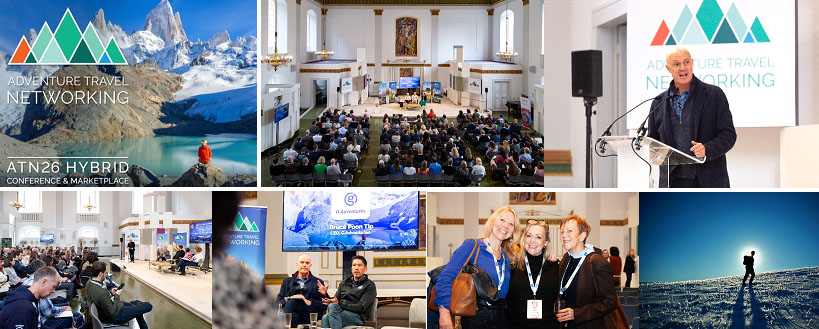
We opened the conference by reflecting on the findings of the ATN26 Market Insights Survey, which revealed a steady – if cautious – confidence among travel stakeholders about the road ahead. I thoroughly enjoyed moderating the session with Roy Barker (Spike), Clare Tobin (Wild Frontiers) and Ashley Toft (KE Adventure), who explored the shifting landscape of client confidence and booking behaviour.
Lyn Hughes (Wanderlust Magazine) was then joined by Tim Henshall (Visit Angola), Sophie Ibbotson (Maximum Exposure) and Joanna Reeve (Intrepid Travel), who together offered a fascinating look at some of the most exciting emerging adventure destinations around the world.
With hindsight, my role moderating the “Worst Case Scenario” session could not have been more poignant. Claire Ingleby (MB Law), John Telfer (Sanderson Phillips), Kathy Atkinson (The Safer Tourism Foundation) and Martin Alcock (Travel Trade Consultancy) shared their considerable expertise on crisis preparedness and response. Their insights now feels particularly timely.
Meanwhile, the lively panel debate on “Demystifying the USA Market”, expertly chaired by Lyn Hughes, brought together Shannon Stowell (Adventure Travel Trade Association), Fiona Marshall (Walker Britain & Europe) and Paul Easto (Wilderness Group). Despite ongoing geopolitical uncertainties, the panel highlighted the accessibility and continuing potential of this important and dynamic market.
The session titled “Video Content – Is It Worth It?”, moderated by Richard Hammond, saw Laura Dewar (Explore Worldwide) and Linda Biggers (Pure Adventure) explore the growing role of visual storytelling in engaging modern travellers.
We were also inspired by Holly Budge (How Many Elephants), who shared the charity’s innovative work building bee-hive fences in Tanzania – an initiative that protects both crops and elephants, while empowering local communities.
The final sessions of the conference demonstrated ATN’s unique ability to bring together some of the industry’s most thoughtful voices to explore the future of responsible travel.
Peter Syme (Disrupt Travel) and Tom McLoughlin (North9) provided valuable insights into navigating the rapidly evolving worlds of marketing and artificial intelligence. Richard Hammond then returned to moderate a thought-provoking session on “Rethinking Tourism”, supported by Alex Narracott (Much Better Adventures), who offered practical guidance on distinguishing genuine cultural exchange from staged or exploitative visitor experiences. Additional perspectives were shared by Thomas Armitt (Planeterra) and Kasia Morgan (Exodus Adventure Travels).
The discussion around Indigenous tourism and the balance between authentic cultural exchange and potential exploitation, was particularly powerful. Hanna Lejon (Nutti Sámi Siida) and Paula Amos (Tourism British Columbia) shared their experiences and perspectives, in conversation with Holly Tuppen.
Finally, I was delighted to interview Bruce Poon Tip, CEO of G Adventures. His knowledge, enthusiasm, foresight and energy filled what felt like far too short an hour. His honest reflections on what truly matters in this fast-evolving industry clearly resonated with delegates.
In light of the extraordinary events that have unfolded since the conference concluded, his emphasis on resilience, responsibility and community now feels more relevant than ever.

In the days since ATN concluded, the escalating conflict involving the United States, Israel and Iran has sent shockwaves through the global travel ecosystem.
For many in the industry, the first impacts were felt in the skies. The Middle East remains one of the world’s most important aviation crossroads, and disruption across the region has inevitably affected flight corridors linking Europe, Asia, Africa and Australasia.
Major aviation hubs including Dubai, Doha and Abu Dhabi sit at the heart of global long-haul connectivity. As airspace restrictions, rerouting and security considerations have intensified, airlines have been forced to cancel, delay or significantly reroute flights. Journeys that once connected seamlessly through the Gulf have suddenly become far more complex.
For travel organisers, tour operators and adventure specialists, the operational consequences have been immediate.
Across the industry, teams have spent long days and sleepless nights reworking itineraries, securing alternative routes, and reassuring clients who suddenly find themselves facing uncertainty about journeys they may have planned for months or even years.
In many cases, the challenge is not simply a flight cancellation. A single disrupted connection can trigger a cascade of logistical consequences: missed internal flights, disrupted ground transport, lost hotel reservations, or delayed expedition departures. Each element requires careful re-planning, often across multiple time zones and supplier networks.
Safety, of course, remains the absolute priority.
Adventure travel often takes clients to remote regions or complex international routes, and ensuring that travellers remain safe, informed and supported has required constant monitoring of evolving government advisories, airline announcements and regional developments.
For those working behind the scenes in travel companies around the world, this past week has been a reminder of the industry’s extraordinary complexity and its remarkable capacity for adaptation.
It is also a reminder that travel professionals frequently operate as crisis managers as much as trip planners.
Yet, if the discussions at ATN highlighted anything, it was the strength and resilience of the global adventure travel community.
The past week has demonstrated that resilience in real time. Operators, agents, airlines and destination partners have worked collaboratively to protect travellers, maintain communication and keep journeys moving wherever safely possible.
In times of uncertainty, the values celebrated at ATN – cooperation, responsibility and a deep commitment to meaningful travel – become more important than ever.
And while the world may once again be reminding us how fragile global mobility can be, it is equally reminding us how determined this industry remains to keep exploration, understanding and human connection alive.








Thank you Jono – after finishing the week on such a high post-conference, it has certainly been a jolt back to Earth! This week has felt like a timely reminder of how valuable it was for the Adventure Travel Networking (ATN) community to come together last week and build strong, supportive connections.
Thanks Anna – ‘people & communication’ sure feel king at the moment.
Great thoughts, Jono, I wholeheartedly agree. The ebbs and flows of the industry are once again affected by events outside of our control, and the importance of having a human at the end of a phone instead of a computer is so important!
Thanks for moderating some truly engaging and insightful panels.